Hiragana, katakana and kanji worksheets
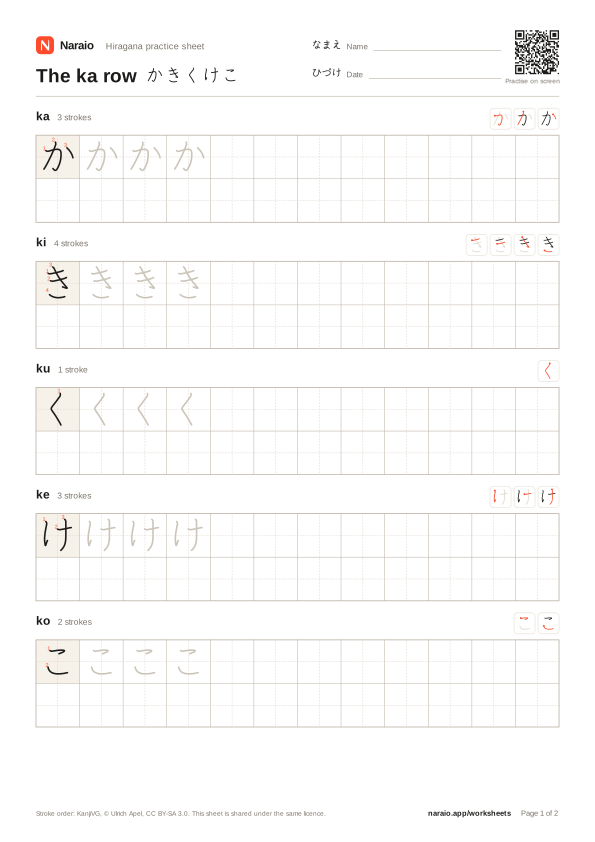
Printable practice sheets in the squares Japanese schoolchildren write in: each character's stroke order, a model to copy, faded copies to trace, then empty squares. Pick a sheet, print it and write. Free, nothing to sign up for.
Worksheet maker
The 46 basic hiragana a row at a time, each row ending with words to write, then the voiced kana, the combinations and two quizzes.
By row
Whole sets
Quizzes
Options
How to practise with a sheet
Ten minutes with a pencil a day does more than an hour once a week. Take one row or a few kanji at a time:
- 1
Watch the order
The frames above the squares add one stroke at a time, the new one in vermilion from the dot where the pen lands. Follow them with a finger before you pick up the pencil.
- 2
Trace the faded copies
The first square holds the model, each stroke numbered where it starts. Write over the faded copies slowly: the order, the direction, and where each stroke stops or flicks.
- 3
Write it alone
Fill the empty squares without looking at the model, and say the sound out loud each time, so the shape and the sound stick together.
- 4
Come back tomorrow
Write yesterday's row from memory before you start a new one. What you can still write after a day or two is yours; what you can't goes back on the list.
What's on a sheet
- Stroke order frames
One frame per stroke: the new stroke in vermilion with a dot where it begins, the ones before it in ink, the ones still to come in light grey.
- The model
The character in the first square, each stroke numbered where it starts.
- Faded copies
Light enough to write over, so your hand learns the shape before it writes it alone. A full row of them, three, or none.
- Empty squares
Each with a dotted cross, to see whether the character sits in the middle and keeps its proportions.
- Kanji sheets
Each kanji's meanings, its stroke count and JLPT level, and its readings: on'yomi in katakana, kun'yomi in hiragana, the okurigana in grey.
- Words to write
Each kana row ends with a few words made only of the kana met so far, to write whole: えき (station) after the ka row.
- A QR code
In the corner: it opens the same characters on screen, where a board checks the order, direction and shape of every stroke you draw.
- Name and date
At the top, as on a worksheet at a Japanese school: なまえ (name) and ひづけ (date).
bunka · culture
Japanese children learn to write in notebooks of squares, many with a dotted cross in each square, the (jūji rīdā, cross guide), to place every part of a character. School compositions, (sakubun), are still written by hand on (genkō yōshi), paper with a square for every character and every punctuation mark, so a teacher can count a 400 character essay at a glance.
Questions about the worksheets
Yes. Every sheet is free to download, print and copy, for yourself or a whole class, with no account. The stroke order comes from KanjiVG under CC BY-SA 3.0, so the sheets carry the same licence: share them as you like and keep the credit at the foot of the page.
Hiragana, one row at a time in the order of the chart: the vowels, then the ka row, the sa row and on. Then katakana, then the kanji of N5. The hiragana chart plays each character's strokes and says its sound, if you want to hear it while you write.
Choose A4 or Letter to match your paper and print at actual size (100%) rather than "fit to page". The squares are then about 15 mm wide, a common size for practising characters by hand.
Yes. Following the order makes a character come out balanced, and it keeps your handwriting readable when you write fast and strokes start to run together. It also makes kanji easier to recognise in handwriting and to look up by stroke count.
Yes. Choose Your own and type up to 40 kana or kanji. Each character gets its stroke order and rows of squares, then each word gets rows to write it whole. For your name, find it in katakana on your name in Japanese first.
Paper can't tell you a stroke went the wrong way. The drawing board on the hiragana chart, the katakana chart and every kanji page can: draw with a finger or a mouse and each stroke is checked for its order, direction and shape.
Keep going
Writing is one of four skills.
Naraio teaches reading, writing, listening and speaking together, from your first kana to N1, with reviews spaced so nothing slips away.
Sources
- Stroke order
- KanjiVG (opens in a new tab) © Ulrich Apel, CC BY-SA 3.0
- Readings and meanings
- KANJIDIC2 (opens in a new tab) © EDRDG, CC BY-SA 4.0
- Words
- JMdict (opens in a new tab) © EDRDG, CC BY-SA 4.0
- JLPT levels
- Jonathan Waller (tanos.co.uk) (opens in a new tab) CC BY
- Word cards
- JMdict (opens in a new tab), KANJIDIC2 (opens in a new tab), Tatoeba (opens in a new tab) CC BY 2.0 FR
Kanji meanings are adapted by Naraio from KANJIDIC2, and where a source has no Spanish we translate its English; both are shared under the same licence. Written by Naraio. Updated . All credits and licences